
Dear Friends,
Last week, a Multnomah County audit revealed that Multnomah County paid $1.2 million more for real estate than independent appraisals said the properties were worth. The County had relied on broker opinions rather than obtaining independent appraisals before buying the properties.
This isn't really a story about real estate.
It's a story about a culture that disregards accountability.
Over the years, County Auditors have identified serious problems in virtually every area of the County's critical work: Homeless Services. Animal Services. Mental Health and Addiction Services. Jail conditions. Contracting.
The problem isn't just that things have gone wrong.
It’s that even when the Auditor has identified problems and proposed solutions, the County has failed to act.
The Joint Office of Homeless Services was audited in 2023. The Auditor identified serious problems with contracting, payments, performance measures and management. When the Auditor returned in 2025, only one of eight recommendations had been implemented.
And this isn’t an isolated example:
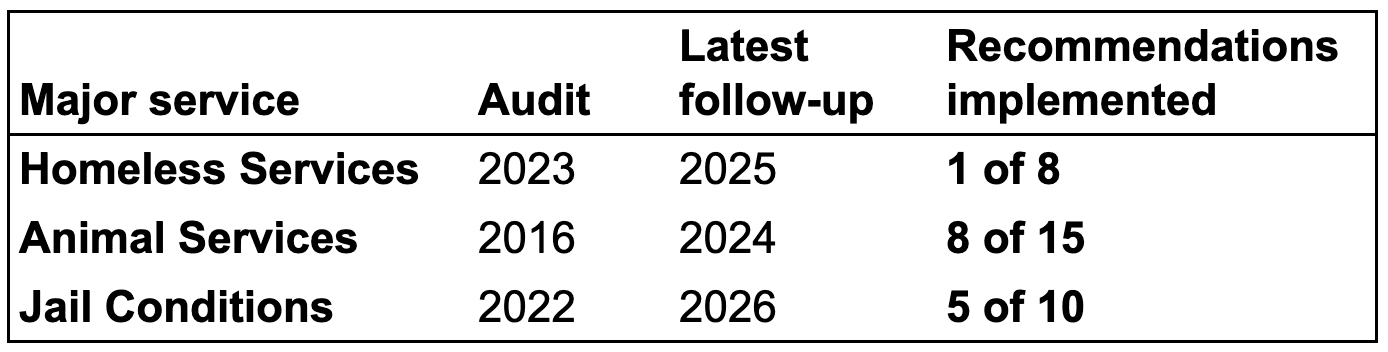
Auditors have raised fundamental concerns about County contracting practices for more than two decades.
But even when the County says it has fixed a problem, it often hasn’t.
Animal Services provides a particularly disturbing example.
After a Hotline complaint, the Auditor found that Animal Services had accumulated nearly $2 million in restricted funds intended for veterinary care, spay/neuter services and adoption outreach, while spending only a fraction of the money.
The Auditor told the County to use the funds for their intended purposes.
A year later, the County had spent most of the money. But instead of using the funds for health, spay/neuter services, or adoption, the Auditor found the County had simply shifted the funds to backfill its budget.
Meanwhile, the Auditor found that Animal Services was adopting out animals that had not been spayed or neutered, and issued a new recommendation to stop this practice.
The disconnect here is shocking.
Even as the County was failing to use restricted funds dedicated to spaying and neutering animals, it was adopting out animals that had not been spayed or neutered, contrary to best practices - and common sense.
To make matters worse, the County's own rules often get in the way of common sense solutions.
A 2023 Homeless Services audit found the County held up a $300,000 payment for months over documentation for just $25 in spending. The Auditor recommended the obvious: hold back the disputed $25, not the other $299,975.
A 2024 contracting audit found something equally absurd: the County took 45 days to pay a $54,607 invoice, including holding it up over documentation for a $4.33 utility charge. Yet by the County's measure, it was paid promptly within 10 days — because the County’s clock didn't start ticking until the invoice had cleared more than a month of inane County processes.
Technically compliant. Completely missing the point.
Accountability isn't rigidly following a process when the process defeats the purpose. It's about protecting public money while getting results.
And these are only the problems that get caught.
The Auditor can't continuously oversee every corner of a roughly $4 billion government. So who catches everything else?
Consider Sunstone Way, a major County homeless-services contractor. After a former finance director became a whistleblower, County reviewers found $3.6 million in allegedly unallowable spending — including payroll costs, alcohol, meals and staff outings. The organization has since closed, and its management is now under criminal investigation.
Too often, serious failures come to light only because an employee, provider, volunteer or reporter sounds the alarm.
And political outrage occurs only after the damage has been done.
Real accountability shouldn't begin after a scandal. It should prevent one.
This is the same pattern we've seen throughout County government: spend first, measure later; discover failure, demand more reporting; then keep doing the same thing.
Before spending millions, County leaders should know what they’re trying to accomplish, how they’ll measure success, what it actually costs, and what they’ll do if it doesn't work.
As a commissioner, I didn't just call out failures. I worked to change the systems behind them — from Animal Services to budgeting to contracting to homeless services to behavioral health — and kept pushing when others moved on.
That same principle is at the heart of my Comprehensive Turnaround Plan.
Tie spending to results. Account for every dollar.
As Chair, we'll set clear goals before we spend money and measure whether we're achieving them. We'll make that information public, track every audit recommendation through completion, and build the internal oversight to identify problems before they become scandals.
We won't stop when a recommendation is marked “implemented.” We'll find out whether it actually worked.
And when something isn't working, we'll change it.
Find the problem. Fix it. Prove it.
That's accountability. And that's how I'll lead Multnomah County.
Sharon