Sharon share a like
Dear Friends,
Everywhere we go, we hear many of the same questions:
What does Multnomah County actually do?
How do the City and County differ?
Why does the County Chair matter?
What is Ranked-Choice Voting?
And, most importantly, why Sharon?
We’ve put together answers to these questions we hear most often. Please share this email with your friends, family, and anyone you know who cares about our County and is ready for real change!
Yours in progress,
Team Sharon
What is Multnomah County and why should I care?
Most critical services. Highest spending. Worst results.
Multnomah County is our region’s social safety net, responsible for crucial health and human services: homelessness, aging, disability, mental health, addiction and public health. It funds the DA, Sheriff and jails. It also oversees libraries, animal services and elections.
Multnomah County has one of the highest marginal income tax rates in the United States and spends more per person than almost anywhere else.
Yet Multnomah County has among the worst rates of unsheltered homelessness in the country. Nationally, we’re one of the few urban areas where homelessness is actually getting worse. And Oregon has the worst prevalence of mental illness among all states—largely driven by its largest county.
Simply put, Multnomah County government is broken. It is failing to provide the essential services that are foundational to our economic vitality, public safety and community health.
What’s the difference between Portland and Multnomah County?
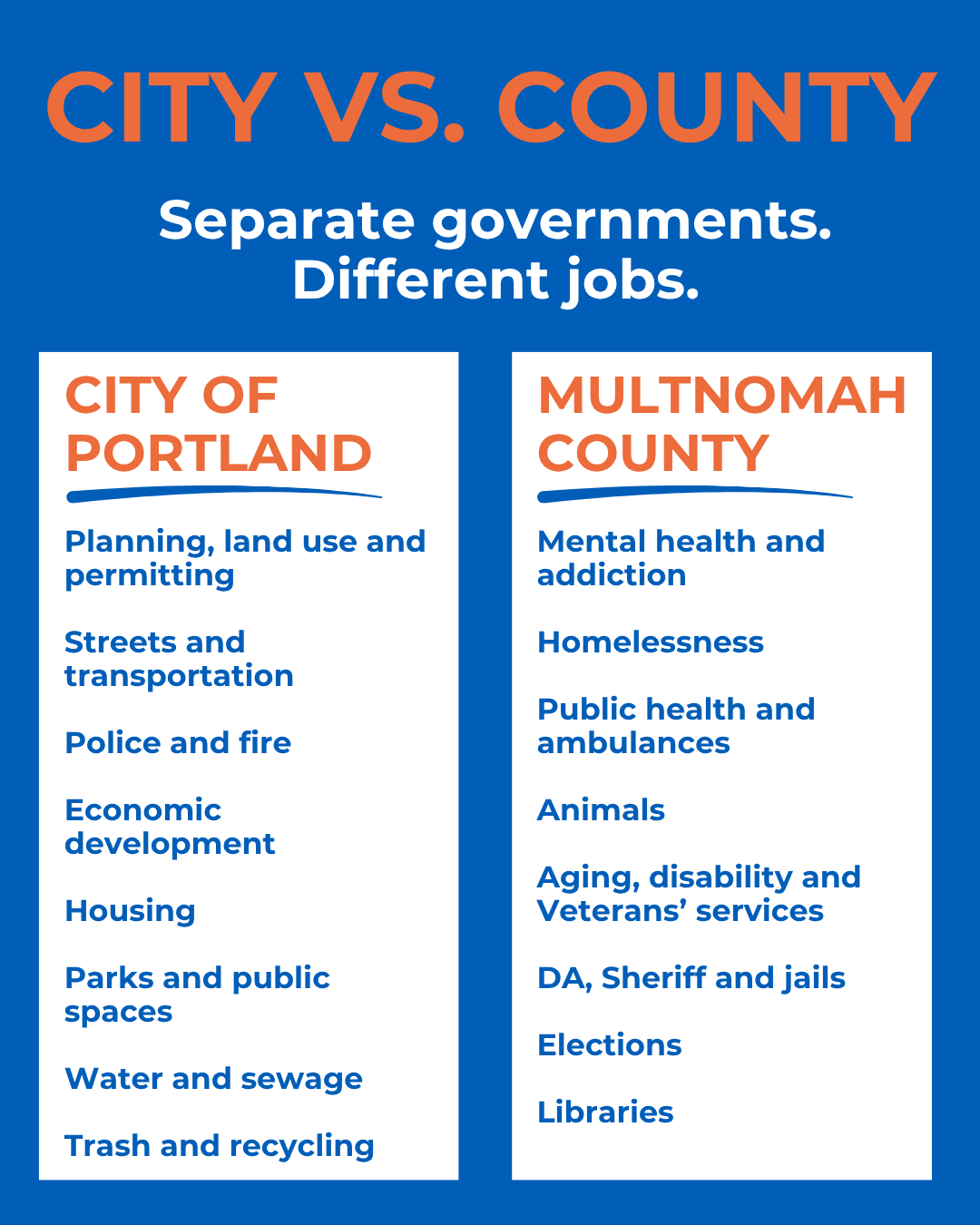
What’s the difference between Portland and Multnomah County?
Multnomah County also includes Gresham, Troutdale, Fairview, Wood Village, and Maywood Park, which have their own municipal governments. And the County provides land use, transportation and other local government services in unincorporated areas.
Why does it matter who's Chair?
The Multnomah County Charter vests tremendous power in the County Chair. The Chair isn't simply one of five commissioners. The Chair runs the government—writing the $4 billion budget, hiring and firing department leaders, overseeing the administration of hundreds of millions in contracts, controlling the executive machinery of the County, and largely determining what comes before the Board when and what information comes out of County government.
That matters because the services the County controls aren't just sidebars to our region’s health, safety and economic viability. They are the foundation of a healthy, safe community where people can recover, neighborhoods can thrive, and businesses and our economy can grow.
Few elected officials—not the Portland Mayor or even the Governor—combine such concentrated authority and resources to shape our region's health, safety and economic future. This presents the County Chair with a unique opportunity to change the trajectory of our entire region.
So how do we fix Multnomah County?
Multnomah County will not be fixed by engaging in business as usual or managing our failed systems better. We must change how the County itself operates.
That requires a fundamental reset, grounded in local expertise, informed by high-performing counties across the country, and built on concrete operational plans with measurable outcomes and aligned budgets.
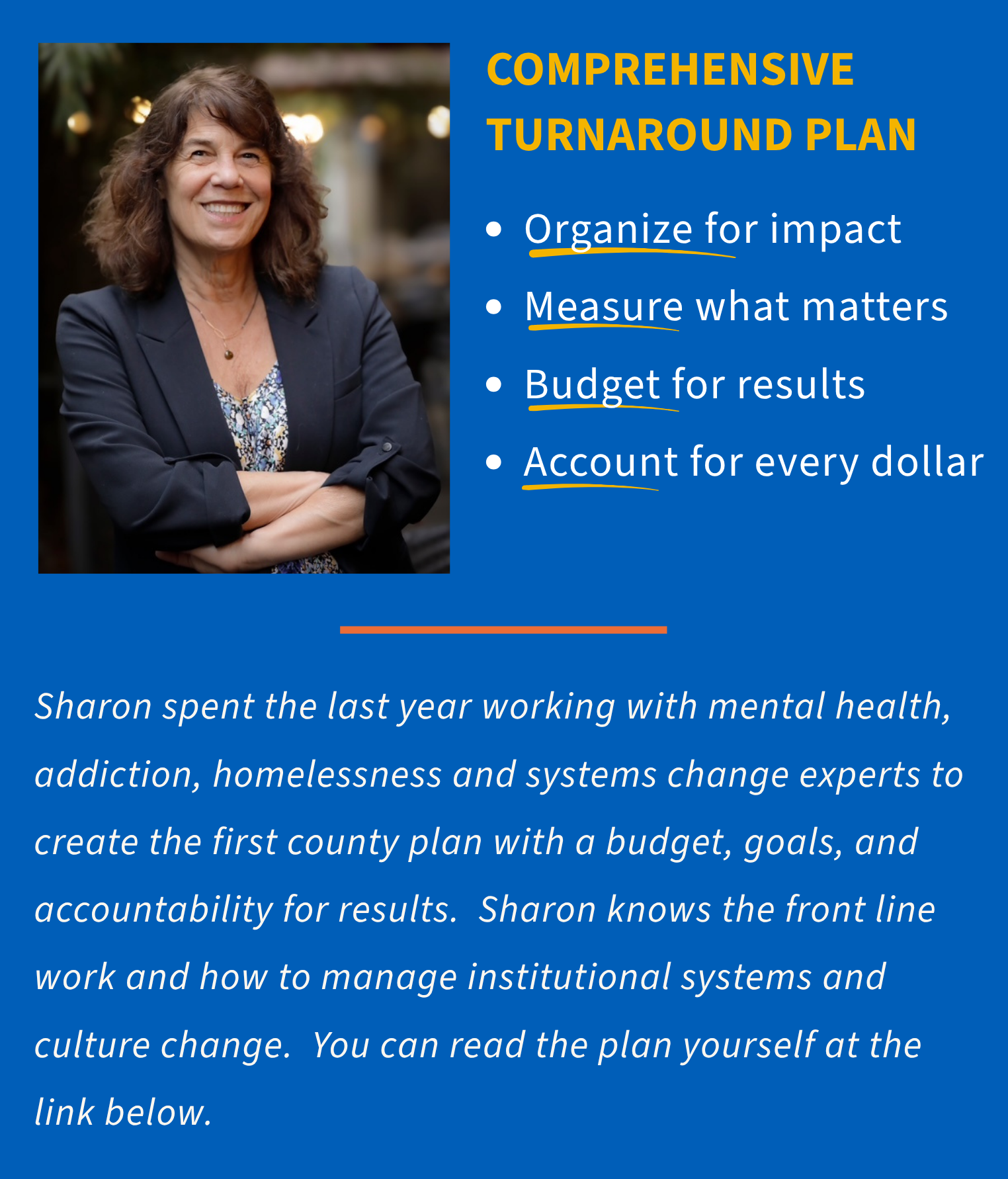
Flyer describing comprehensive turnaround plan
Why Sharon?
Sharon brings unprecedented experience with the County's core services at both the policy level and on the front lines.
As an emergency physician, Sharon spent nearly two decades caring for people in crisis whom the County had failed to serve—people suffering from mental health crises, overdoses, homelessness and violence.
As president of the state College of Emergency Physicians, Sharon spearheaded successful efforts by Oregon's ERs to address opioid abuse, and curb frequent ER use by coordinating people's care.
As a County Commissioner, she used bold leadership to end our ambulance crisis after the County Chair spent nearly two years stuck in a contract dispute that kept ambulances from responding to 911 calls.
Sharon knows how the County works and where to intervene to fix what's broken. She has relationships with both system leaders and boots on the ground, and has repeatedly brought together coalitions to develop solutions to core County problems—including homelessness, mental health and addiction, animal services, emergency preparedness, climate change and public health.
Critically, Sharon is the ONLY candidate who has told voters what she would actually do if elected, with a comprehensive plan for change that lays out exactly how she will turn the County around.
And she will enter office with a core team of experts who already understand the work of the County and are prepared to drive results.
Why didn’t Sharon seek organizational endorsements?
Sharon chose not to seek organizational endorsements in this race because endorsement decisions are often made behind closed doors, without transparency to the public or even an organization’s members. They can also come with expectations or commitments that interfere with governing independently.
While Sharon does not actively seek endorsements, she does accept endorsements that are independently offered, without conditions or commitments. But she will not make promises in exchange for political support.
When elected, Sharon will answer only to the people of Multnomah County.
Ranked choice voting - it’s easier than you think
We hear a lot of questions from people worried about RCV, but it’s actually pretty straightforward:
Rank the person you want to be Chair first. Do not rank anyone you do not want to be Chair.
If you have other choices, rank them second or third. You're not obligated to rank every candidate.
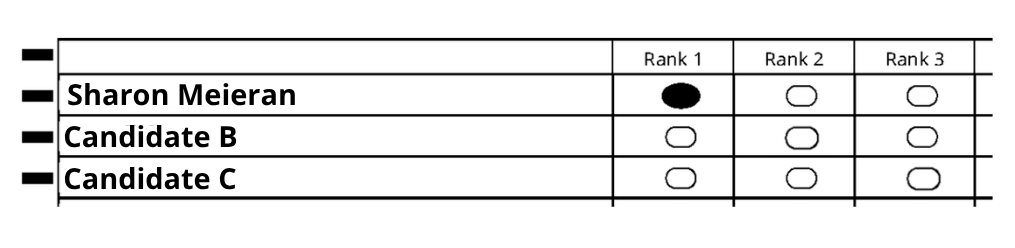
Rank Choice Voting Example
Join the Movement
Fixing Multnomah County isn’t as hard as they’re making it. Nor is it as expensive.
It starts with meaningful goals, measuring real results, tying spending to outcomes, and demanding accountability.
And it can only happen when we elect bold, honest leaders who want to DO something not just BE something.
Sharon is something we don’t often see in politics–the real deal.
Please share this message far and wide. The complete voters' pamphlet statement is included below.
Voters' Pamphlet Statement
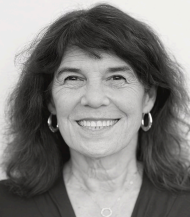
Sharon Meieran smiling at camera
Sharon Meieran
Occupation: Founder, Fixing Multnomah County; Doctor, Portland Street Medicine
Occupational Background: Multnomah County Commissioner, District 1; Emergency Room Doctor; President, Oregon College of Emergency Physicians; Medical Director, Oregon Foundation for Reproductive Health, National Alliance on Mental Illness Civil Commitment Workgroup; Emergency Department Information Exchange Governance Board; Physician, Air Care Helicopter-Based Medical Care; Court Appointed Special Advocate; TALK Line Child Abuse Prevention Crisis Counselor Educational Background: UCSF School of Medicine, Doctor of Medicine; San Francisco State University, post-baccalaureate/pre-med courses; UCSF School of Law, Doctor of Law; UC Berkeley, Bachelor of Arts degrees in Economics and English
Prior Governmental Experience: Multnomah County Commissioner, District 1; Co-Chair, Health and Human Services Committee, Association of Oregon Counties; Governor’s Behavioral Health Task Force; Prescription Drug Monitoring Program Advisory Commission; Portland Community Oversight Advisory Board Regarding Police Use of Force for Mental Health Crises; Oregon Coalition for the Responsible Use of Medications; National Governor's Association Task Force on Prescription Opioid Misuse; Emergency Department and Mental Health Rules Task Force
Multnomah County is broken.
As an emergency room doctor, every day I’d treat people with addiction, mental illness, abuse and neglect – the very problems the county is responsible for addressing.
We have among the worst rates of homelessness in the United States. Multnomah County is the reason Oregon ranks last in the nation for mental illness. Yet we spend more per person than almost anywhere else.
Highest spending. Worst results.
That’s why I first joined the county commission. That’s how I learned Multnomah County reacts instead of plans, spends money without specific goals, and answers to no one. The politicians only care about deflecting blame.
As president of the state College of Emergency Physicians, I led efforts by Oregon's ERs to curb opioid abuse before government even recognized the problem. As county commissioner, I used bold, honest leadership to end our ambulance crisis, after the county chair spent nearly two years mired in a contract dispute that kept ambulances from responding to 911 calls.
For the last year, I've worked with experts to create what no other candidate has - a specific plan with a real budget that will:
Create effective mental health and addiction treatment
Get people safely off the streets
Tie all spending to results
Account for every dollar spent
You can read it at fixmultco.com.
During this campaign, I decided not to seek organizational endorsements because I don’t want to make backroom promises to get elected. I want to build a social service system that protects safe neighborhoods, helps businesses succeed, and supports a strong community. We should be a national example of a progressive community committed to living its values.
Multnomah County has real problems, but fixing them doesn’t have to be as hard as they’re making it. We can spend less but do so much more.
Together, we can build a county worthy of the people it serves.
Thank you for reading this, for caring, and for voting.